Why Your Export Documentation Is Costing You More Than You Think
Why Your Export Documentation Is Costing You More Than You Think
Every exporter I meet swears their paperwork is fine. Then I ask what they paid last year in demurrage, discrepant LCs, and reassessed duty, and the room goes quiet.
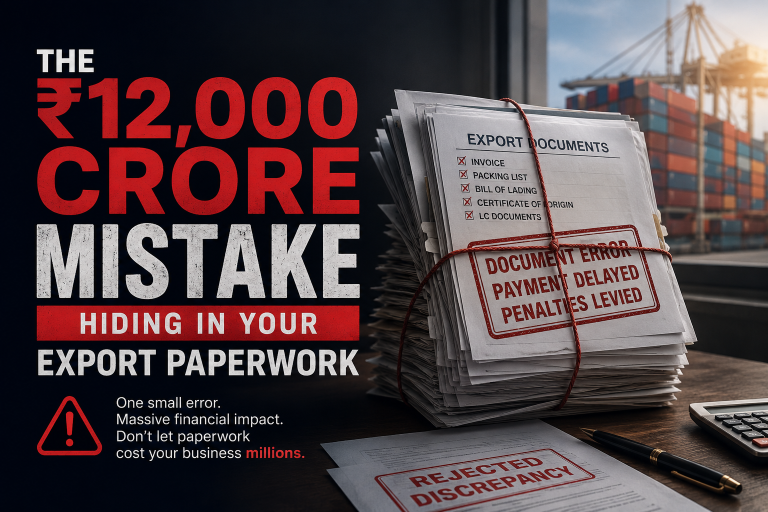
Here's why. In May 2025, US customs turned away at least fifteen Indian mango shipments at LA, San Francisco, and Atlanta over documentation irregularities. Not quality. Not pests. Paperwork. The bill: roughly ₹4.2 crore, gone in a single week (BizzBuzz). Now multiply that across every port, every product, every week of the year. That's how you get to the number industry watchers keep quoting: Indian exporters lose an estimated ₹12,000 crore a year to entirely avoidable mistakes.
You never see this as one bill. It hides inside "logistics costs." Inside "bank charges." Inside a buyer who just quietly stops reordering. FICCI-cited research puts it plainly: 70% of shipping delays at Indian ports trace back to documentation, not congestion, not vessels (WareIQ). It's a tax nobody budgets for because nobody sees it coming.
Five mistakes cause almost all of it.
The wrong HS code. One wrong digit and you've invited a full reassessment, differential duty, 15% annual interest, and a Section 112 penalty running from ₹10,000 to the full value of your goods. Confiscation adds another 10–25% redemption fine on top (Readerr). A shipment that should clear in hours turns into a weeks-long dispute.
A missing certificate of origin. No CoO, no preferential duty under CEPA or ASEAN (Trade in Bharat). Your container just sits there and in India, that costs ₹5,000 to ₹20,000 a day in demurrage alone (WareIQ).
A packing list that doesn't match the invoice. Customs checks this every time. A quantity mismatch doesn't get you a query it gets you flagged for fraud. Logistics firms serving Gujarat's textile exporters have watched buyers source elsewhere while a shipment sat under investigation over exactly this (RiseUp Shipping).
A discrepant LC. Globally, 60–80% of first-time LC presentations contain at least one discrepancy (TradeFinance.training; Impello Global). Every one of those buys the issuing bank a legal reason to hold your payment for weeks while you wait for a waiver.
A late shipping bill. No shipping bill, no Let Export Order, no LEO, nothing loads. Switch ports without re-registering your AD Code, and ICEGATE rejects the filing outright (Trade in Bharat). The demurrage clock starts before your cargo has even left India.
Same five failures, on repeat, across thousands of shipments because most exporters only catch them after filing, when every fix costs money.
That's the gap our SPO Document Guardian system closes. It checks your invoice, packing list, HS code, CoO, and shipping bill against each other and against your LC before anything leaves your desk. Not after the bank flags it. Not after customs holds it.
The upside is measurable. SWIFT Trade Analytics found that exporters running pre-presentation audits cut their LC discrepancy rate from 68% to 12%, recovering the cost of the audit within three transactions (DocShipper). That's the shift Document Guardian is built to hand every exporter who runs paperwork through it.
Want to know what your own documentation has actually cost you? We'll pull your last few shipments and show you, line by line. Free. No pitch attached.
What sets Exim apart isn't saying documentation matters — every forwarder says that. It's catching the HS code about to trigger a notice, the certificate about to expire mid-transit, the packing list one digit off, before any of it becomes your 11 p.m. problem with a container already at sea. We don't promise zero errors. We promise to catch the one that would have cost you a customer.
Sources: BizzBuzz · WareIQ (FICCI) · Readerr · Trade in Bharat · RiseUp Shipping · TradeFinance.training · Impello Global · DocShipper (SWIFT)

.png)
